The craze behind Data Structures and Algorithms

I am a Student who lives and breathe Software development.
Need for Data Structures and Algorithms.
Whenever we dream of MAANG companies, the first thing that strikes our mind is data structures and algorithms. It always seems impossible until it is done. It is not always the big salary jobs that motivate people to study things but the PASSION towards technology. While creating effective algorithms, data structures are essential. It delivers abstraction and reusability. While performing tasks like data processing, retrieval, or storage, using the right data structures can help programmers get the job done faster.
Data structures and algorithms
An expertly designed format for arranging, processing, accessing, and storing information is referred to as a data structure. Data structures come in both simple and complex forms, all of which are made to organize data for a certain use. Users find it simple to access the data they need and use it appropriately thanks to data structures.
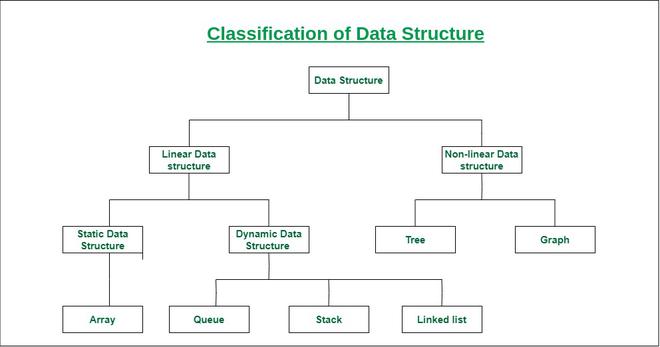
Classification of Data Structures
Linear Data Structure
A linear data structure is one in which the elements of the data are ordered consecutively or linearly, with each element being connected to its immediate preceding and following contiguous elements.
Array, stack, queue, and linked list are examples of linear data structures.
Static data structure:
The memory size of a static data structure is fixed. A static data structure's elements are simpler to access.
An array is a kind of this data structure.
Dynamic data structure:
The size of a dynamic data structure is adjustable. It can be randomly updated while the program is running, which is considered to be efficient considering the code's memory (and space) complexity.
Queue, stack, and other such data structures are examples.
Non-Linear Data Structure
Non-linear data structures are those in which the organization of data elements is not linear or sequential. We cannot explore every element of a non-linear data structure in a single operation.
Trees and graphs are two examples of non-linear data structures.
